How Do Super Bowl Squares Work?
Squares School11 min read · July 29, 2026
Super Bowl squares work by selling every square on a 10 by 10 grid, randomly assigning the digits 0 through 9 to each row and column once every square is claimed, and paying out a prize to whoever holds the square that matches the last digit of each team's score at set points in the game. Nobody picks their numbers, nobody needs to follow football to play, and the same board covers the first quarter, halftime, the third quarter, and the final score.
That much is the short version, and it is usually where most explanations stop. What actually helps once you are staring at a blank grid is the rest of it: how much a square should cost, how a single prize pool gets divided across four scoring periods, what happens if the game goes to overtime, and whether some squares genuinely win more than others. On that last point, we pulled the last-digit result from 1,424 real NFL games played between 2021 and 2025 to find out, and the answer is more specific than most guides bother to check.
How Is a Super Bowl Squares Grid Set Up?
A Super Bowl squares grid is set up as a 10 by 10 board of 100 squares, with one team assigned to run along the columns and the other team assigned to run along the rows. Every participant claims one or more squares before anything else happens, usually by paying a set price per square and putting their name or initials inside it. If you want a physical sheet for the party wall, our printable Super Bowl squares template prints a board with your team names, price and prizes already on it.
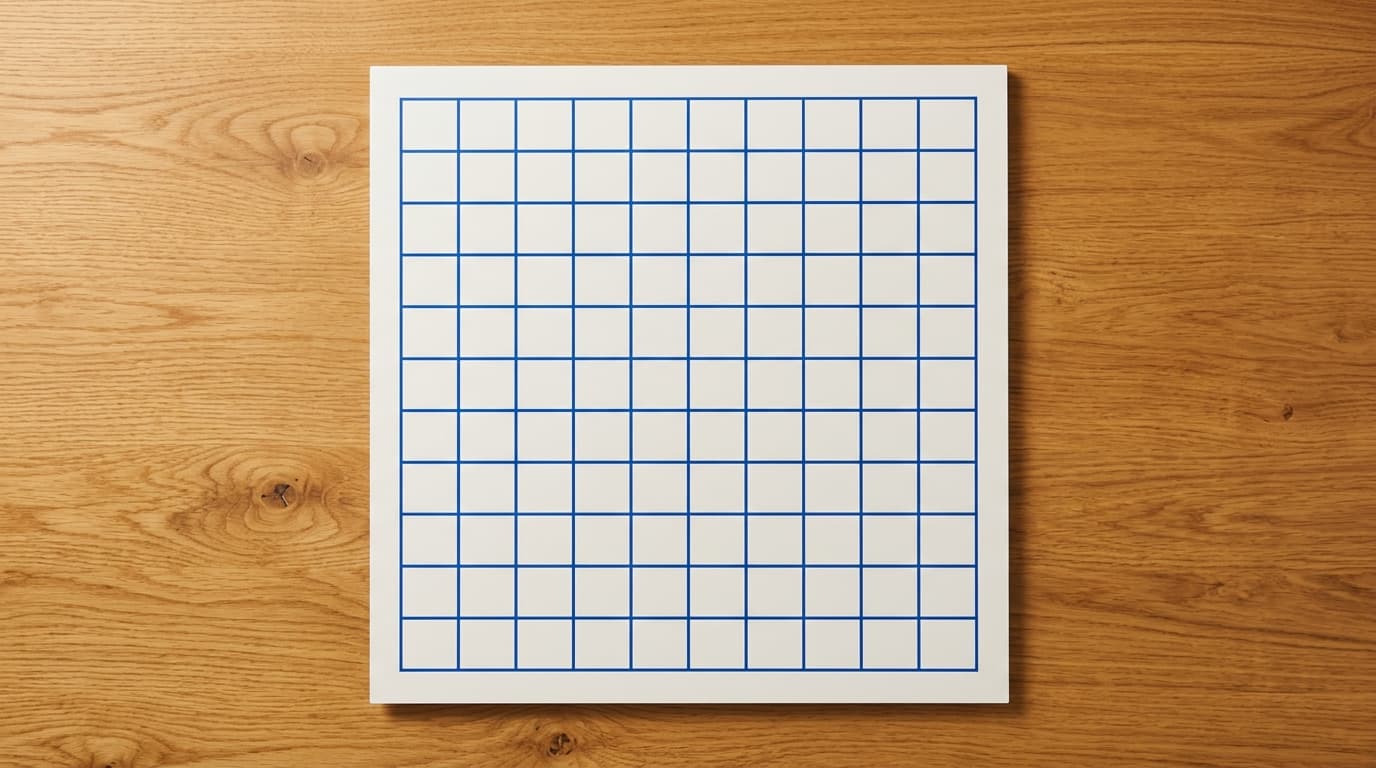
A full hundred-square grid is the standard and the most recognizable format, and it is what most Super Bowl parties default to since almost everyone in the room has seen one before. Smaller formats exist too. A 25-square grid pairs two digits per axis, so a single square covers four of the hundred possible score combinations instead of one, and a 10-square format skips rows and columns entirely, putting a single digit on each of ten squares with the winner decided by both teams' combined score added together rather than by matching two separate digits. Our breakdown of every football squares grid size walks through all four standard formats if a hundred squares is more than your group actually wants to fill.
You will also hear the same hundred-square board called a Super Bowl block pool, or just boxes, blocks or a grid pool. Those are all names for this exact format rather than different games, so if someone invites you to a block pool, everything on this page applies unchanged.
It genuinely doesn't matter which team runs along the columns and which runs along the rows, and most hosts just default to home team on one axis and away team on the other since it is easy to remember once the game starts. What matters far more is how many squares you actually want to sell. A group that likes everyone claiming exactly one square plays differently than a smaller group happy to have a few people each hold several, and either approach fills the same hundred-square grid just fine.
Whichever size you choose, the squares sell out before anyone touches the numbers.
How Do the Numbers Get Assigned to Each Square?
The numbers get assigned by randomly drawing the digits 0 through 9 and placing one along each row and one along each column, done only after every square on the board has been claimed and paid for. A common way to draw them is pulling folded slips from a bowl one at a time, though a digital board can randomize them instantly with the same result. If you are running a paper grid and want the draw done for you, our Super Bowl squares number generator produces both rows of digits in one click.

Waiting until the board is full before drawing numbers is the detail that keeps the entire game fair. Nobody, not even the host or the person who bought their square first, ever picks which digits they end up holding. Early buyers choose which physical square they want first, but that choice happens before the numbers exist, so it carries no real advantage. Assigning digits before the board fills would mean people who join later never got a genuine shot at the good numbers, which is exactly the kind of dispute a host wants to avoid.
Once the digits are drawn and placed, the board locks completely. No swapping squares, no new entries, and no changes of any kind from that point forward, since every square only had an equal shot at winning before the draw happened.
There is one variation worth deciding on before you draw anything. A single set of digits covering the whole game is the standard, and it is what almost every Super Bowl party runs, but some boards draw a fresh set for each scoring period instead, so the square you hold sits at different numbers in the first quarter than it does at the final score. Drawing every period spreads the winning across a wider group and hands everyone a genuinely new shot four times over, at the cost of the host running the randomization four separate times and every player having to re-check their digits before each quarter. Either one is fine. What is not fine is deciding mid-game, so tell the group which version they are buying into before a single square sells.
How Do You Know Which Square Wins?
You know which square wins by taking the last digit of each team's current score and finding the square where those two digits meet on the grid. If the home team is leading 17 to 13 at the end of the first quarter, the winning square is wherever the home team's column digit of 7 crosses the away team's row digit of 3, and whoever's name sits in that square wins that quarter's prize. Carry the same check into halftime, the third quarter, and the final score, using whatever the score happens to be at each of those moments, since every scoring period gets checked and paid on its own.
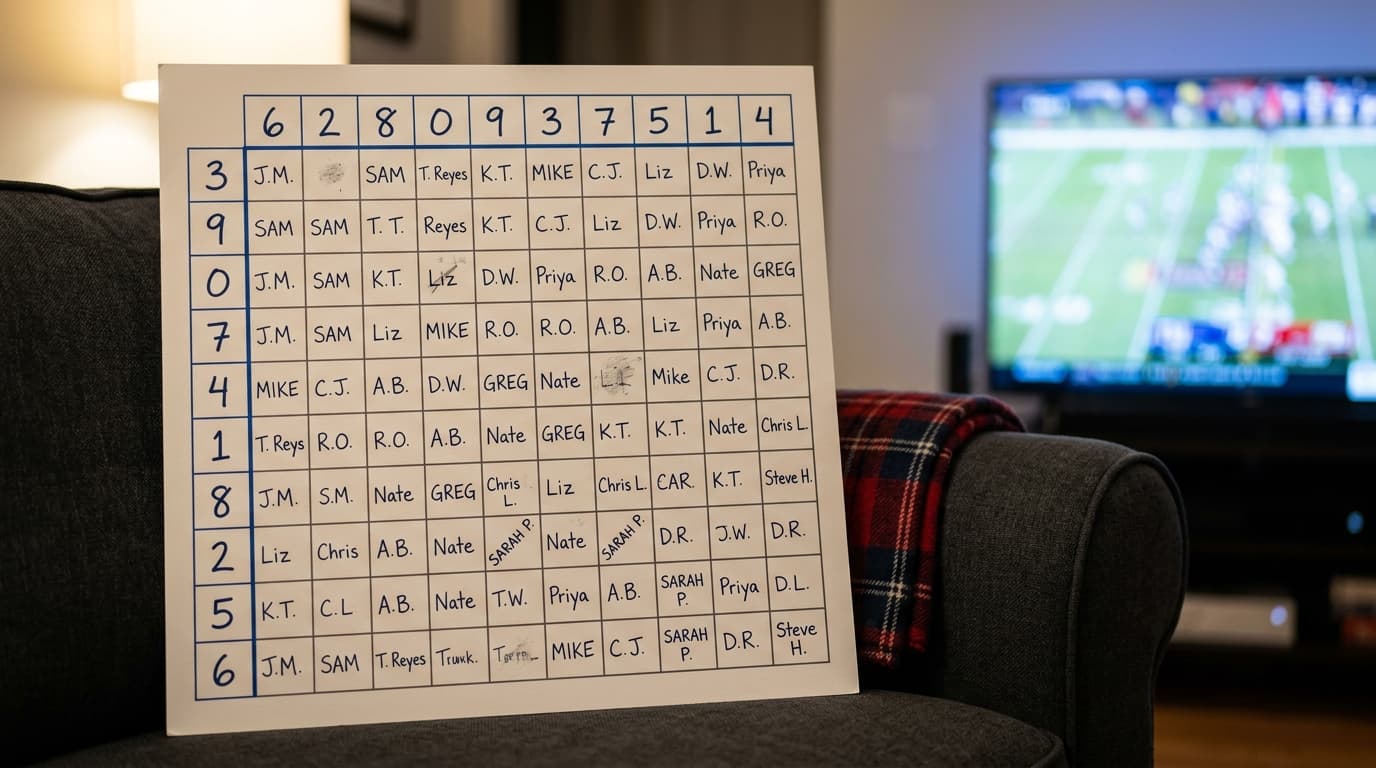
Most boards check the score, and pay a winner, at the end of the first quarter, halftime, the third quarter, and the final score, with the final score usually carrying the biggest prize since it is the result everyone remembers. A smaller group of hosts add a bonus for the reverse score rule, which pays whoever holds the same two digits flipped between the teams, so if 7 and 3 wins the main prize, the square holding 3 and 7 collects a smaller bonus on top. Treat that one as optional rather than something every board needs.
Two situations trip people up every year: what happens if the game goes to overtime, and what happens if the same square wins more than once. Overtime is rare enough that plenty of hosts skip a dedicated prize for it and just let the final score stand as the last one paid, and if one square happens to win twice across different scoring periods, the simplest and most common approach is just paying it again rather than moving the prize elsewhere. Our football squares rules deep dive covers both of those situations, along with the reverse score rule, in full detail if your board wants to plan for them ahead of time. If you want those calls made for you rather than explained, our guide to Super Bowl squares rules goes through every ruling a host sets before the draw with a recommended default for each one.
How Much Does It Cost to Play Super Bowl Squares?
There is no fixed cost to play Super Bowl squares, since the host sets whatever price fits the group. According to our data, the most common prices hosts choose for a Super Bowl or NFL squares board are $1, $2, $5, and $10 a square, though plenty of boards land above or below that range depending on who is playing.

A higher price per square raises more money once the board fills but takes longer to sell, while a lower price sells faster but caps what the board can bring in overall. Group size changes that math as well. A bigger group splits the same hundred squares across more people, so each person only needs a few squares to help fill it, which supports a higher price. A smaller group needs each person to claim more squares to fill the same board, so a lower price gives everyone room to actually sell out.
None of this needs to be complicated for a casual watch party. Pick a price your group would happily pay without a second thought and weigh it against how many people are actually in the room, since a board that never fills raises nothing no matter how high the price sits. Every square costs the same flat price regardless of who is buying or how many they claim, and selling stops once the grid fills.
How Does the Prize Pool Get Split Up?
The prize pool gets split up by deciding, before a single square sells, how much of the total money collected goes to each scoring period, with the final score usually taking the largest share since it decides the whole game. A single board covers every quarter, so there is no need to run separate boards per quarter or per half.
Here is one common shape for that split on a full hundred-square board charging $10 a square, which raises a $1,000 prize pool. Scale the dollar amounts up or down to match your own square price and headcount, since the percentages are the part worth copying.
| Scoring Period | Prize | % of pool |
|---|---|---|
| First quarter | $150 | 15% |
| Halftime | $200 | 20% |
| Third quarter | $150 | 15% |
| Final score | $500 | 50% |
The arithmetic scales straight off the price per square, since a full board is always a hundred of them. At $25 a square that same split works out to a $2,500 pool paying $375, $500, $375 and $1,250, and at $50 a square it is a $5,000 pool paying $750, $1,000, $750 and $2,500. Our football squares payouts guide covers the other common splits and how a reverse score bonus comes out of the same pool rather than from anywhere new.
Some hosts simplify further and pay only on the final score and halftime, which still uses the same board and the same random numbers, just with two prizes instead of four. Others fold a cause into the math, setting aside a portion of the pool for a charity or a team before splitting the rest as prizes. Our Super Bowl squares fundraiser guide walks through exactly how that split works if you are running the board to raise money rather than purely for fun.
Which Squares Actually Win the Most, According to Real NFL Data?
Some squares do win more often than others, though every single square on a hundred-square grid is still far more likely to lose than win. We pulled the last-digit score from 1,424 real NFL games across the 2021 through 2025 seasons, at the end of every scoring period, to see exactly how often each of the hundred possible pairings actually came up.

Pooling every scoring period together, the single most common square to hold is a 7 for the home team paired with a 0 for the away team, which came up 424 times, a win rate of 7.33%. The digit 0 shows up on one team's score in 18.12% of every scoring period we counted, more than any other digit, with 7 close behind at 15.45%, which is why squares built around those two digits dominate the top of the list. The worst square to hold across five full seasons is a 2 for both teams, which has come up only twice. Put together, the top ten squares out of the hundred possible pairings account for 47.9% of every scoring period in our entire dataset, meaning a tenth of the grid covers almost half of all the scoring we counted.
None of this makes any single square a sure thing. Even the best performing pairing in five years of real data still loses far more often than it wins, so treat this as useful context for setting expectations, not a strategy for picking a winner, since every number is assigned randomly and none of this is knowable ahead of the draw anyway. Our football squares odds tool lets you look up any specific pairing across the first quarter, halftime, the third quarter, the final score, or overtime separately, and compare the regular season against the playoffs.
How Do You Actually Run a Super Bowl Squares Board Today?
You run a Super Bowl squares board today by handling the whole process online instead of on a printed grid, from selling squares and collecting payment to drawing the numbers and checking the score after every quarter. A printed grid still works fine for a small, casual group, but it puts every part of the job on the host: tracking who paid, drawing numbers by hand, and checking the score against the board manually four separate times. Our guide to running Super Bowl squares online walks through what that looks like end to end on the night.
A platform like Play Squares keeps one central record of who claimed which square and who has paid, randomly assigns the numbers the moment the host clicks to draw them, and checks the live score against every square automatically so nobody has to squint at a printed sheet during the game. That matters most for the one habit every host actually needs regardless of method: keeping a single, up-to-date record of payments, since a payment should track the number of squares a person claimed rather than a specific square number, given that squares can still shift between people right up until the numbers get drawn.
Whichever way you run it, the deadline that actually matters is finishing sign-ups and collecting every payment before the numbers get drawn, not a fixed number of days before kickoff. In practice, plenty of real boards keep filling right up until the game starts.
Live score tracking is where that saves the most actual work. Play Squares follows the score in real time while the game is still being played, not just once a quarter officially ends, and highlights the pending winner for the current scoring period based on where the score sits right now. What that removes is the back-and-forth: nobody has to text the host to ask whether their square won, who took the first quarter, or which digits they hold again, because one central board answers all three for everyone at once. The host gets to watch the game instead of running the math four separate times, and the players get something to watch update live rather than a text to wait on.
Frequently Asked Questions
What happens if the Super Bowl goes to overtime?
What is the reverse score rule?
Can you pick your own numbers on a Super Bowl squares board?
What happens if the same square wins more than once in a game?
Can players see who's about to win before a quarter ends?
How much does it cost to play Super Bowl squares?
Do you need to understand football to play Super Bowl squares?
Is a Super Bowl squares board considered gambling?
Ready to Set Up Your Board?
Play Squares handles the grid, the number draw, payment tracking, and live scoring through every quarter, so your board runs itself once the squares sell out.