Football Squares Payouts: How to Split the Prize Pool
Squares School12 min read · August 10, 2026
Football squares payouts work by pooling the price of all 100 squares into a single prize pool and paying a share of it at the end of each scoring period to whoever holds the square where the two teams' last digits meet. The most common structure hands 20 percent of the prize pool after each of the first three quarters and the remaining 40 percent on the final score, so a board at $10 a square pays $200, $200, $200 and then $400. Everything else is the host's call, including whether a reverse score prize gets paid alongside each winner and whether any of the money comes off the top for a cause. The one rule that genuinely matters is that every figure gets decided and written down before the first square sells.
Almost everything written about this topic works through a single Super Bowl example at $10 a square and then stops, which leaves a host running a Thursday night game or a college board guessing at the parts nobody covers. What does a $2 board actually pay each quarter? Where does the money for a backward prize come from if the prize pool is already fully allocated? Who collects when a square nobody bought turns out to be the winner in the third quarter? Below are real numbers you can copy straight onto your own board.
How Do Football Squares Payouts Work?
Every square on the board costs the same amount, all of that money goes into one prize pool, and the pool gets paid back out to players in shares at the end of each scoring period. A football game gives you four natural scoring periods in the three quarter breaks and the final score, so most boards pay four winners, and the host never funds any of it personally because the players collectively paid for every prize when they claimed their squares.
Finding each winner takes one step. At the end of a quarter you take the last digit of each team's score and look for the square where those two digits cross, with the home team's digit along the top and the away team's digit down the left side. A game sitting at 17 to 10 pays whoever holds 7 for the home team against 0 for the away team, and a game at 24 to 13 pays the square at 4 against 3. Nobody chose those digits, because the numbers get randomized only after every square has been claimed and paid for, which is exactly what makes a squares board fair to the person who joined last.
The prize pool is a fixed amount, so every choice you make about one period takes money from another, which is why all four shares get decided together rather than one at a time. Our full guide to hosting a football squares pool walks through the rest of the setup if this is your first board.
What Does a Board Pay at Each Price Per Square?
A full 100-square board collects exactly 100 times the price of one square, so a $5 board holds $500 and a $25 board holds $2,500, and the standard structure pays 20 percent of that after each of the first three quarters with 40 percent going to the final score. The table below runs that arithmetic for every price point a football board commonly uses, so you can find your own row rather than scaling somebody else's Super Bowl example.
| Price per square | Prize pool | Each of first three quarters | Final score |
|---|---|---|---|
| $1 | $100 | $20 | $40 |
| $2 | $200 | $40 | $80 |
| $5 | $500 | $100 | $200 |
| $10 | $1,000 | $200 | $400 |
| $25 | $2,500 | $500 | $1,000 |
| $50 | $5,000 | $1,000 | $2,000 |
According to our data, the prices real football boards use most often are $1, $2, $5 and $10 a square. A dollar a square fills almost instantly and gets everyone in the room involved, which is what you want at a party where half the group barely follows football. A $10 or $25 board raises far more and makes the last prize genuinely worth watching for, though it asks more of every person you invite and a board that never fills raises nothing at all. Group size settles it more than anything else: a bigger room spreads the same 100 squares across more people and carries a higher price comfortably, while a smaller group needs everyone to claim more squares and is a good reason to keep the price low.
What Is a Forward and Backward Payout?
A forward and backward payout pays two winners at every scoring period instead of one, using what most hosts call the reverse score rule. The forward winner holds the square where the digits sit in their real order, and the backward winner holds those same two digits reversed, so a quarter ending 17 to 10 pays the square at 7 for the home team against 0 for the away team, and also pays the square sitting at 0 against 7.
The mistake hosts make here is treating the reverse prize as an extra rather than as a slice of money that already belongs to somebody. There is no new money in a squares board, so a reverse prize has to come out of the same prize pool as the forward one, and the sensible way to handle that is to divide each period's share between the two winners before you collect a dollar. On a $1,000 board paying 20 percent a quarter, that might mean $150 to the forward square and $50 to the reverse in each of the first three quarters, with the $400 final score share splitting into $300 forward and $100 backward. Eight people go home with something instead of four, and the total still comes to exactly $1,000.
Then there's the case nobody writes about, which comes up more often than you would expect. When both teams finish a period on the same last digit, a 7 to 7 tie or a 24 to 14 scoreline, the forward square and the backward square are the same square, and the person holding it collects both slices. Say so in your rules before the game, because a first quarter ending 0 to 0 is common enough that you will eventually have to answer it live while everyone is watching. Our deep dive on football squares rules covers the reverse score rule alongside overtime, ties and repeat winners in more detail.
It is genuinely optional. A big group of a hundred different people benefits from spreading eight prizes around, while a small group where six people bought most of the board is usually happier with four meaningful prizes than eight thin ones.
How Should You Split the Prize Pool Across the Quarters?
Give the final score 40 percent of the prize pool and divide the rest evenly across the first three quarters, which is the structure we recommend and the one most football boards land on. Weighting the end that heavily is what keeps a room watching a game that stopped being competitive in the third quarter, and it makes the last prize feel like the one worth staying for without turning the earlier quarters into a formality.

| Structure | 1st | 2nd | 3rd | Final |
|---|---|---|---|---|
| Even four ways | $250 | $250 | $250 | $250 |
| Weighted final | $200 | $200 | $200 | $400 |
| Escalating | $150 | $200 | $250 | $400 |
All three rows add up to the same $1,000, which is the only test a payout structure genuinely has to pass. All three are equally fair, because every square had the same chance before the numbers were randomized; the choice is purely about the kind of night you want. Bigger prizes concentrated at the end mean more excitement and fewer winners, while flatter prizes spread the money across more people and give more of the room something to take home. One naming point either way: plenty of hosts call the second prize the halftime prize and plenty call it the second quarter prize, so write the exact wording once where everyone claiming a square can see it.
What Other Ways Can You Pay Out a Board?
Paying at the quarter breaks is the default because it matches the rhythm of a football game, but a host who wants more winners or a livelier middle of the game has real options. Every structure below obeys the same rule as the standard one: the prize pool is fixed at whatever the board collected, and any extra prize is funded out of that rather than from anywhere new. Each row below is a complete $1,000 board.
| Structure | What it pays | The rest of the $1,000 |
|---|---|---|
| Pay on score changereplaces the quarter prizes | $25 a change, capped at $600 | Whatever is left becomes the last prize, so a 12-change game pays $300 out and leaves $700 |
| Pay per minutereplaces the quarter prizes | $10 a minute across 60 minutes, so $600 | $400 last prize |
| Touching squaresruns alongside the quarter prizes | $5 to each of 8 neighbours on 4 winners, so $160 | $180 each quarter, $300 last prize |
| Unlucky numbersruns alongside the quarter prizes | $25 each for 5 against 5 and 2 against 2, so $50 | $190 each quarter, $380 last prize |
Paying on every score change is the one that transforms how a board feels, and it is its own format rather than an addition, replacing the quarter prizes entirely. The moment the scoreboard moves, the square matching the two new last digits collects. It is the best answer there is to a blowout, because a touchdown in a game nobody is watching anymore still pays somebody in the room.
The mechanic that makes it work is the cap, because the number of score changes is unknowable in advance and an uncapped per-change prize can outrun the prize pool. Fix the amount per change and cap what it can consume: $25 a change up to $600 of a $1,000 board. If a wild game reaches that cap, either reduce the per-change amount for the rest of the game so every change still pays something, or stop at the cap and let the remainder ride on the last prize. Tell players the consequence up front: the last prize is not a fixed number here. It is whatever the score changes did not consume, so a twelve-change game leaves $700 for the end and a shootout leaves less, and nobody knows the figure until the game is over.
Paying per minute of game clock is the other standalone format, handing a small amount to whoever holds the winning square as each minute ticks past. It divides cleanly, because regulation is always 60 minutes: $10 a minute spends $600 of a $1,000 board and leaves $400 for the last prize. What makes it genuinely different is that it rewards squares that sit on the score for a long stretch rather than squares that catch a moment, so a team that scores early and then holds the ball pays its square over and over. It also asks the most of whoever is tracking the game, which is the reason to run it on a board that follows the score for you.
Touching squares pays the neighbours, and unlike the two formats above it runs alongside the ordinary quarter prizes rather than replacing them. When a scoring period winner is decided, every square touching it collects a small prize too, so $5 a neighbour across four winners costs $160 and leaves the usual prizes nearly intact. Set it up so the grid wraps at the edges, with the top row treating the bottom row as its neighbour and the last column treating the first as its neighbour. That gives every square exactly eight neighbours and the same shot at a neighbour prize. Without the wrap an edge square has five and a corner only three, so whoever drew the outside of the grid quietly carries a worse board than everyone else.
Instant payouts for unlucky numbers fix the oldest problem in squares, the player who reads their digits the moment the numbers are randomized and knows they are done for the night. Some pairs really are close to hopeless, and our own numbers put figures on it: across 1,424 NFL games from 2021 through 2025, out of 5,785 scoring periods, 2 against 2 came up exactly twice and 5 against 5 came up nine times, while 0 against 0 landed 403 times. Paying those squares $25 each before a snap is played keeps two people in the room and costs the prize pool almost nothing. Our football squares odds data shows the full ranking if you want to pick the unlucky pairs from real history rather than by reputation.
All of this runs on Play Squares as bonus prizes, each one a prize with its own name and amount that you award to whichever square earned it. Because a bonus prize is just a titled amount, the structures above are only the obvious uses, and hosts invent their own all the time: a prize for the biggest lead of the night, one for the first square to win twice, one for whoever holds the square nobody wanted.
What Do Payouts Look Like on a 25-Square Board?
A 25-square board collects a quarter of what a 100-square board does at the same price, so either the price per square goes up or the prizes come down, and the percentages you split it by don't change at all. Twenty five squares at $10 collects $250 and pays $50 after each of the first three quarters with $100 on the final score, while the same board at $20 a square collects $500 and matches what a $5 hundred-square board pays.
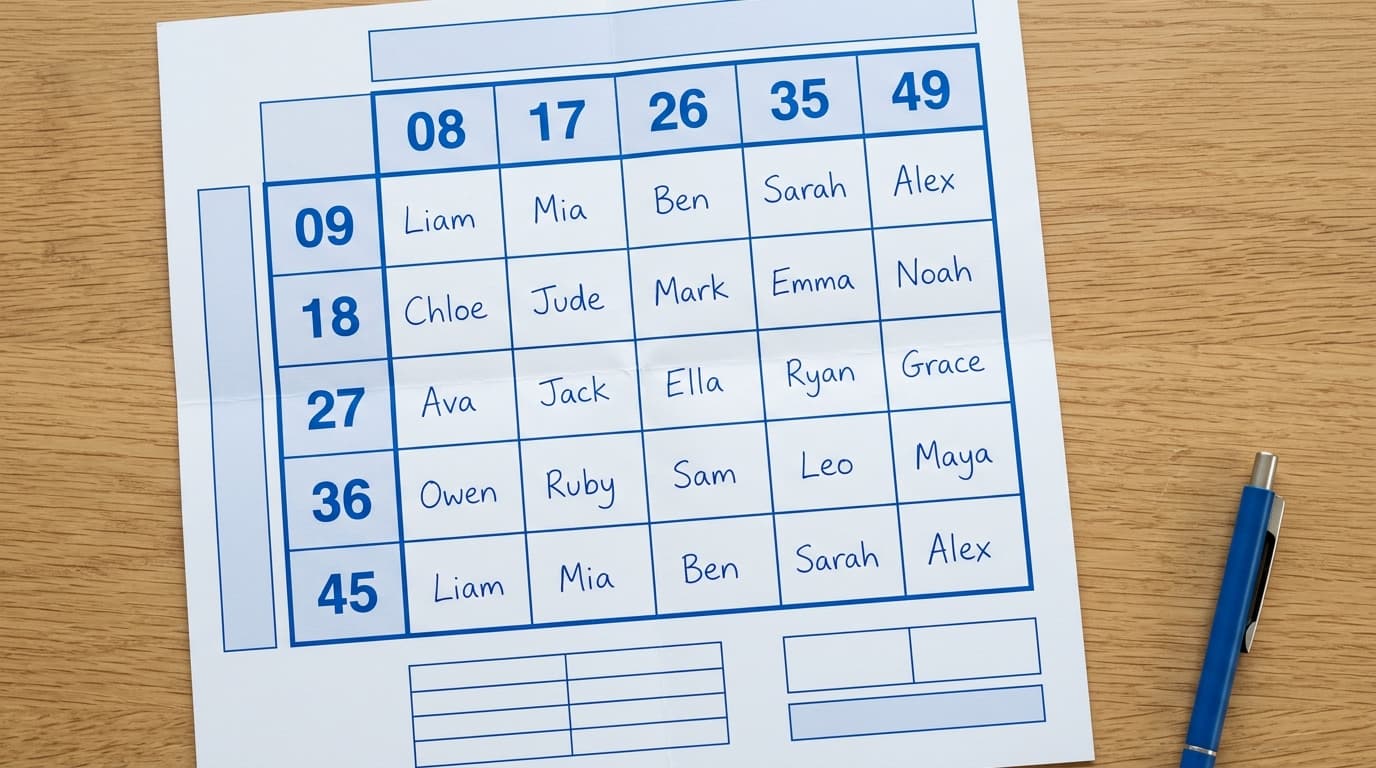
The mechanic behind a smaller grid catches new players out, and it's worth explaining rather than assuming. On a 5 by 5 board each axis carries two digits per row and column rather than one, so a single square covers four of the hundred possible digit combinations instead of one. That gives every square four times the chance of winning any given period, which is exactly why a smaller board can charge more per square without feeling like worse value. Our breakdown of every squares grid size walks through all four standard formats and how the digits get paired on each.
The 10-square format needs its own handling: a single strip of ten boxes numbered 0 through 9, where the winner holds the last digit of both teams' scores added together, so a game at 14 to 7 sums to 21 and pays the square marked 1. Ten squares at $10 collects only $100, so most hosts either price it higher or pay a single prize on the last score rather than splitting a small prize pool four ways.
What Happens If the Board Doesn't Sell Out?
Fill it. The host, or a few willing players between them, buys the remaining squares at the price everyone else paid, and the problem disappears before it starts: the board is complete, the prize pool stays at the figure you advertised, every prize goes to a real person, and nobody spends the fourth quarter working out who a blank square belongs to. It is also usually a smaller sum than it feels like, since boards that fail to fill are almost always sitting a handful of squares short rather than half empty.
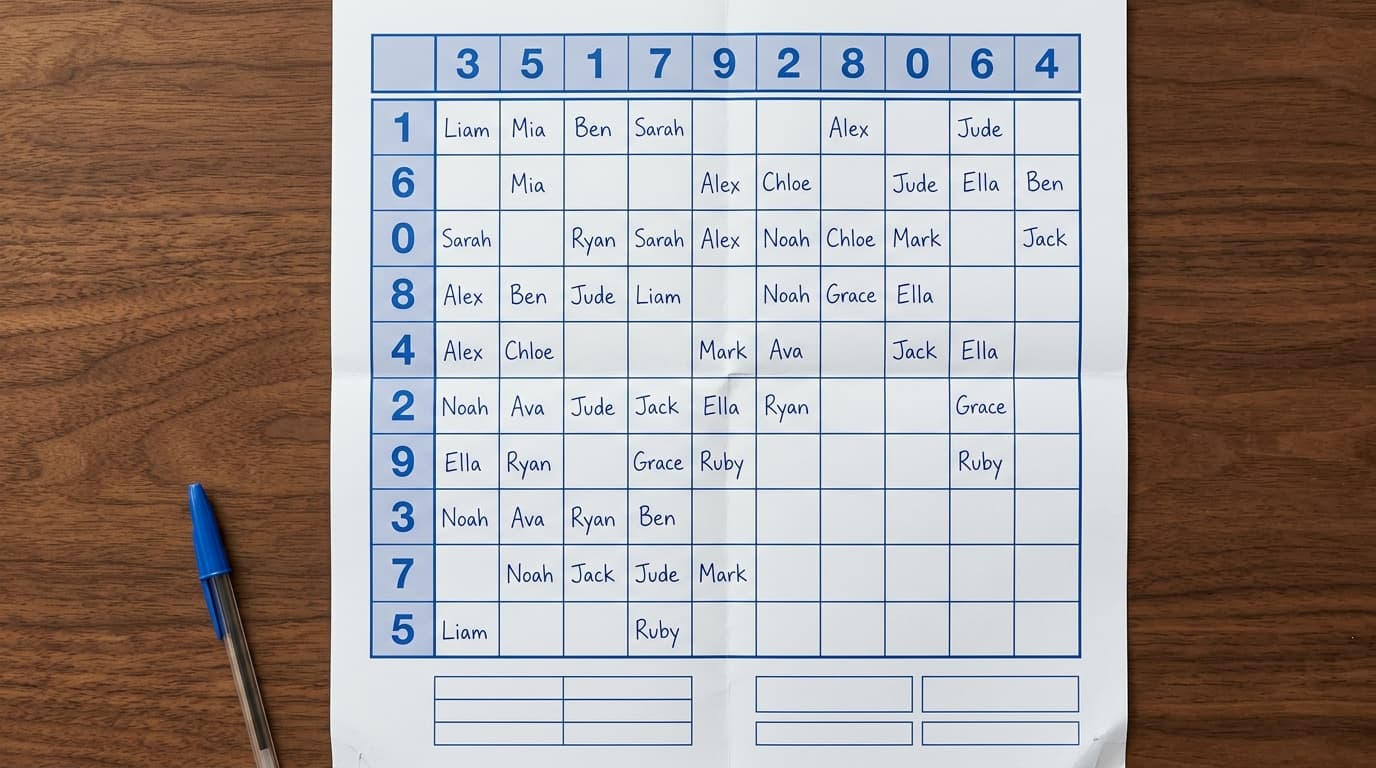
When that genuinely isn't feasible, three fallbacks will do the job, and they are not equally good. What they have in common is that the prize pool never quietly shrinks: every dollar collected still finds a real player.
| Approach | How it works | Verdict |
|---|---|---|
| Fill the board | Host or players buy the remaining squares at the same price | Cleanest, do this |
| Roll the prize over | An unclaimed quarter prize joins the next one, growing the later prizes | Best fallback |
| Next square up | A predetermined rule moves the prize to another owned square, either a set step like +7 or a random draw | Works, needs writing down |
| Spread it across the other prizes | An unclaimed prize is distributed over the other prizes that do have real winners | Works for any prize |
Rolling the prize over is the best of the three because it needs no arithmetic and makes the rest of the game better: a first quarter prize nobody claimed simply makes the halftime prize bigger for everyone still holding a square. The one case it can't answer by itself is the last prize landing on an empty square, since there is no later period to roll into, so pair it with one of the two options below for that case.
A next-square-up rule moves the prize to a different square by a rule you set in advance, and it suits hosts who would rather have a mechanical answer than a judgement call. The step can be anything agreed beforehand: add 7 to each of the winning digits, wrapping past 9 back to 0, and keep going until you land on a square somebody owns, or simply draw a random square on the grid and pay whoever holds it. A set step and a random draw are equally valid, because the entire value of this approach is that the rule was written on the board first and nobody can argue with it afterwards.
Spreading an unclaimed prize across the other prizes works for any prize, not only the last one, and it has a quiet advantage over moving the prize to another square: the money goes to people who genuinely won something on this board rather than to a square chosen by a rule. The cost is that it changes prize amounts players were already quoted, so it only works if you said so before the numbers were drawn. That caveat applies to every option here, which is the real argument for just filling the board and never needing any of them.
How Much Goes to the Cause on a Fundraiser Board?
About half. When a squares board is raising money for a team, a school or a cause, the arrangement people recognize is an even split: half of what the board collects funds the prizes and half goes to the cause. That ratio is worth sticking close to, because it keeps the prizes big enough that the board actually sells while still sending real money where it was meant to go. Whatever number you land on, it belongs on the board in plain words next to the price, before anyone claims a square.

That even split changes the pricing arithmetic in a way that catches first-time fundraiser hosts out. If you want to raise $1,000 for a youth team and half of what you collect goes to prizes, the board has to collect $2,000, which means dividing your goal by 50 rather than by 100 and landing on $20 a square. Dividing by 100 only works if every dollar collected goes to the cause and nobody gets a prize at all, which is a raffle rather than a squares board. Our walkthrough of running a squares fundraiser covers the rest of that setup, and the same math applies to any football game rather than only the Super Bowl. If the Super Bowl is your game, our Super Bowl squares payout breakdown works the same structures through a full 100-square board.
What to Settle Before the First Square Sells
Six decisions cover a football squares payout completely, and every one of them belongs in writing before a single square is claimed. Set the price per square, set the percentage each scoring period pays, decide whether you're running forward and backward prizes, decide whether any bonus structure is joining them and what slice of the prize pool funds it, decide how you'll close the gap if the board doesn't fill, and state whether anything comes off the top for a cause. Write the prizes down as the actual dollar figures you intend to hand over, because those numbers are what people claimed a square against and they are the ones that have to hold.
Everything after that is watching football. Running the board on Play Squares handles the grid, the randomization, payment tracking and live scoring for you, including showing who is currently on track to win the quarter while it's still being played, so nobody has to message the host to ask whether their square is live. If you're setting one up for the coming season, our NFL squares page covers running a board through the regular season, and how to play football squares is the version written for the players you're about to explain all of this to.
Frequently Asked Questions
How do football squares payouts work?
How much does a $10 football square pool pay out?
What does forward and backward mean in football squares?
How much should the final score winner get?
What happens if a winning square was never sold?
How much of a football squares board should go to the cause on a fundraiser?
Can you pay out a football squares board more than four times?
Is running a football squares pool with real payouts considered gambling?
Ready to Set Up Your Football Squares Payouts?
Play Squares handles the grid, the number randomization, payment tracking and live quarter-by-quarter scoring, so every football squares payout is worked out for you the moment the score changes.