World Series Squares: How to Run One Board Across a Best-of-Seven
Squares School11 min read · August 5, 2026
World Series squares work by selling all 100 squares on a 10 by 10 grid before Game 1, randomly assigning the digits 0 through 9 across the top for one team and down the left side for the other, and paying a prize after each game to whoever holds the square matching the last digit of each team's score. Most boards score on combined runs, hits, and errors, which is what we recommend, though runs alone works fine too. One board covers the entire series rather than a fresh grid for every game, so everyone buys in once and stays invested from the first pitch through whichever game ends it. The one decision that separates a smooth board from a messy one is how the prize pool gets split when nobody knows in advance whether the series will run four games or seven.
That last part is where most World Series squares boards come apart, and it's the part almost nothing written about the format actually solves. The usual advice is to wait until the series is over and then divide the prize pool by however many games got played, which sounds tidy until you realize it means no player knows what a single game is worth while they're watching it. The other common failure runs the opposite direction, where a host sizes each game's prize as though the series will go the distance and then finds themselves holding a third of the money with nothing left to pay it out on after a sweep.
This piece walks through the whole thing, from an empty grid to a paid winner across a best-of-seven, with the scoring baseball boards actually use, a payout structure that always distributes every dollar collected no matter when the series ends, and a worked example pulled from a real World Series box score.
How Do World Series Squares Work?
A World Series squares board is a single 10 by 10 grid of 100 squares that covers the whole series, with the two pennant winners fixed on the axes and every game paying out against that same grid. Players claim squares by putting their name inside them and paying the set price, and none of them have any idea which digits they're getting while they claim, because the numbers don't exist yet.
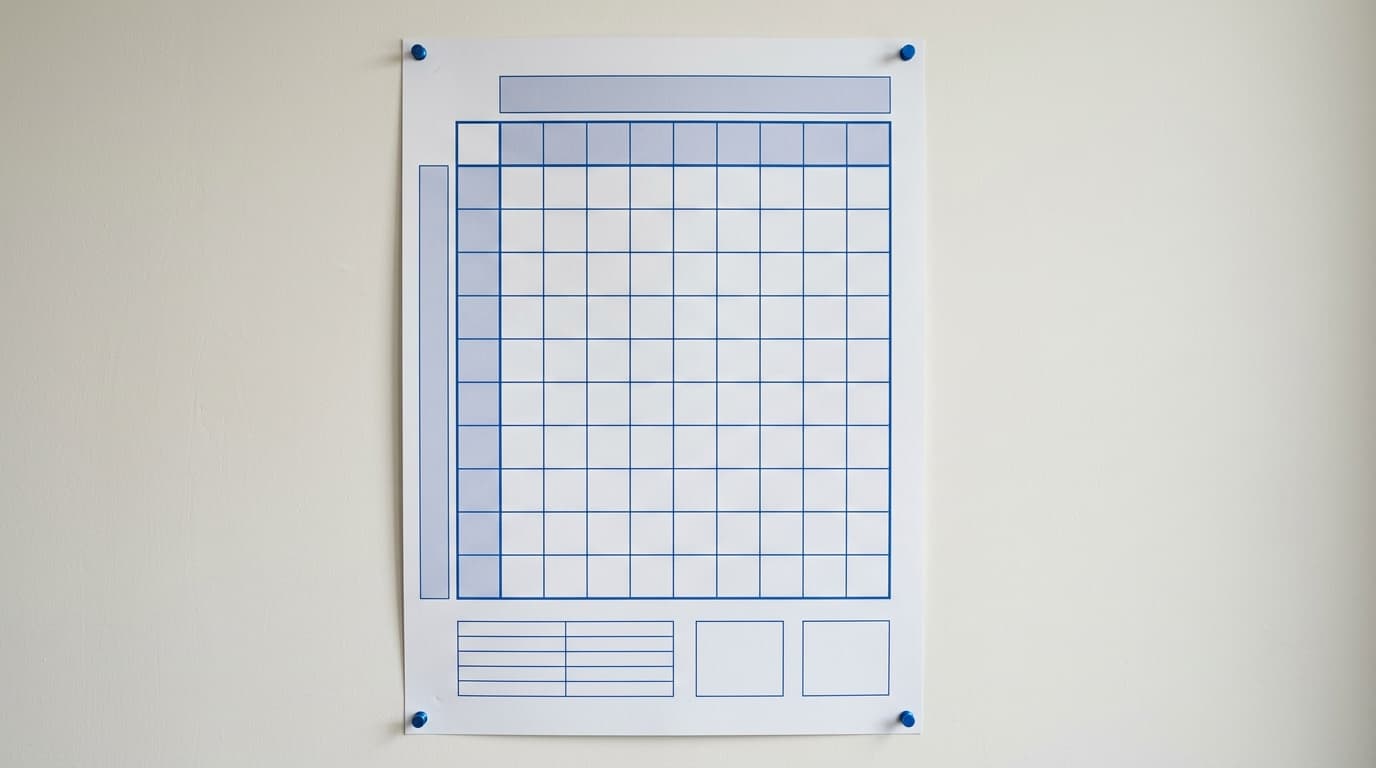
Once every square is claimed and every payment is in, the host randomizes the digits 0 through 9 along both axes. Home field changes hands partway through a World Series, so put Game 1's home team along the top and Game 1's away team down the left side and leave them there for the whole series. Which team goes on which axis doesn't really matter, but picking one convention and sticking to it keeps the board readable in Game 6 as easily as in Game 1.
A full 100-square grid is the standard and the most recognizable shape, though a 25-square grid works too by pairing two digits per axis so one square covers four of the hundred possible combinations. Our breakdown of every squares grid size walks through all four standard formats, and the sizing logic carries straight across from football to baseball.
What makes the format fit a best-of-seven so naturally is that one purchase buys a rooting interest in every game of the series instead of just one night. Someone who barely follows baseball ends up checking a box score on a Tuesday because their square is live again, and the group has something in common for the better part of two weeks rather than a single evening.
Why Do Most World Series Squares Use Runs, Hits, and Errors?
The scoring method we recommend is each team's combined runs, hits, and errors, written as R+H+E, because runs by themselves cluster the winning digit at the low end of the grid. A team crossing the plate three or four times in a game is a normal night, so a runs-only board keeps landing on the same handful of digits, and while every square can still win, the wins spread far more evenly once hits and errors get folded in.
The fairness argument is the main one, and two practical reasons sit alongside it. All three numbers already appear in the box score the moment a broadcast puts one on screen, so nobody has to dig for anything or track a stat by hand. It's also a better watch, since a diving stop that turns into an error and a two-out single that scores nobody both move the board, which gives the defensive half of every inning something riding on it instead of only the moments when somebody scores.
Our full explainer on how baseball squares work goes deeper on R+H+E and on running a board through the regular season rather than only in October.
None of that makes R+H+E the only correct way to run a baseball board. Runs alone is perfectly fine, and groups get creative with all kinds of variations, whether that's runs plus hits, total bases, or something invented at the office. There aren't wrong ways to run a squares pool. What actually matters is settling on your scoring method before squares go on sale and writing it down where everyone can see it, since it changes which digits are worth holding and every player deserves to know the rule they bought into.
How Do You Set Up the Board Before Game 1?
Setting up a World Series board means selling every square and collecting every payment first, then randomizing the numbers once, and only then letting the series start. The order matters more than anything else in this section, because the format is only fair while the digits are still unknown to everybody including the host.

Sign-ups can run right up to first pitch of Game 1, and sometimes a little past it if a few squares are still open. The real cutoff isn't a date on the calendar, it's the randomization: once the numbers are assigned, the board locks completely, with no new entries, no swapped squares, and no changed claims. That rule is what makes the whole thing fair, since every square only has an equal shot while the digits are still unassigned, and letting somebody join afterward means picking a winner after the fact rather than taking their chances like everyone who bought in early.
Players can pick their own squares or let the host pick for them, and either way it's any unclaimed square on the board. What nobody picks is their digits, and that's worth saying out loud to any first-time player who asks which numbers are good, because at the moment they choose a square there are no numbers on the board at all. Claiming early gets you a wider choice of positions on the grid, but no edge whatsoever on the digits.
You can also re-randomize the numbers between games if you want every game to start from a fresh draw. Some groups like that and others decide it's more work than it's worth, and both are legitimate ways to run the board. Like every other setup option, the only real rule is that you decide it in advance and write it down for the group, since arguments come from rules that appear halfway through a series rather than from the rules themselves.
Collecting the money is the other half of setup, and a digital record beats an envelope and a notepad every time. What matters is keeping one central record of who has paid and how many squares their payment covers, rather than tying a payment to a specific square position, since which square a person ends up holding can still shift while the board fills. Our full guide to hosting a squares pool covers the shared setup steps in more depth if this is your first board of any kind.
How Should You Pay Out a Series That Might End in Four Games?
Set a fixed prize for every game except the one that clinches the series, and let that clinching game pay out whatever is left in the prize pool. That single rule handles the entire problem, because it works identically whether the World Series ends in four games or goes the full seven, and it distributes every dollar collected without the host ever holding money they have nothing to pay it out on.
Here's what that looks like with real numbers. Take a full 100-square board at $10 a square, which collects $1,000. The only number you have to choose is the fixed prize for a non-clinching game, and that one choice sets everything else, because the clinching game simply takes whatever the earlier games didn't. The table below shows what the clinching square collects at three different fixed prizes, across every series length.
| Series length | $75 a game | $100 a game | $125 a game |
|---|---|---|---|
| 4 games (3 earlier) | $775 | $700 | $625 |
| 5 games (4 earlier) | $700 | $600 | $500 |
| 6 games (5 earlier) | $625 | $500 | $375 |
| 7 games (6 earlier) | $550 | $400 | $250 |
Read down any column and every scenario adds up to exactly $1,000. Read across a row and you can see the real trade-off: the smaller the fixed prize, the more the clinching game carries. At $75 a game a sweep hands one square $775 of the $1,000, which some groups love and others find lopsided, while $125 a game spreads the money across more winners and leaves the clincher with $250 in a seven-game series. There is no correct answer in that table, only the one your group would rather play.
If you want a recommendation, choose from the higher end, $100 or $125 a game. That keeps every individual game of the series worth a respectable amount on its own, so nobody is watching Game 3 for a token prize, and it still leaves the clinching game the biggest payout on the board even in the scenario where the series goes the full seven.
Whatever a single game is worth, you can also split that amount across scoring periods within the game however you please rather than paying it all on the final line. Baseball's scoring periods are innings, so a $125 game might pay $25 at the end of the third, $25 at the end of the sixth, and $75 on the final score. Any split works as long as it adds up, and weighting the end more heavily is the usual instinct. Three winners a night instead of one keeps more of the group in it across a long series, though every extra prize thins out the ones that remain, so it's worth deciding how many winners you actually want before you start splitting a game up.
Whichever numbers you land on, lock them in before the first square sells and never touch them afterward. Once players have paid for squares, the prize pool and the split are settled, and a host who revises either one partway through a series creates exactly the drama the structure exists to prevent, no matter how fair the new version is. Decide it in advance, write it down where everyone can read it, and then let the games decide the rest. Our deep dive on squares rules covers the rules worth settling up front in more detail, and they carry over to a baseball board unchanged.
What Does a Winning Square Look Like in a Real World Series Game?
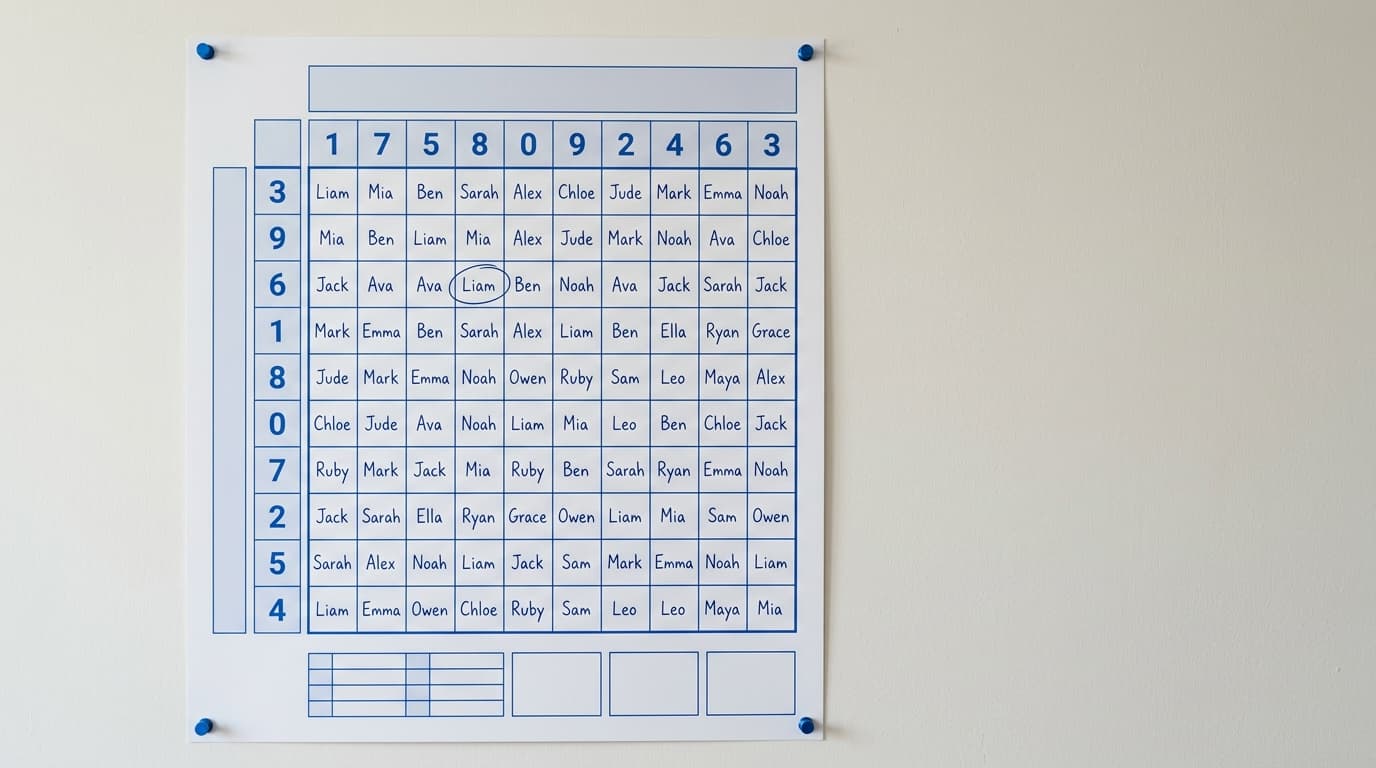
Reading a winner on an R+H+E board takes two steps: add each team's runs, hits, and errors together, then take the last digit of each total and find where those two digits meet on the grid. Game 7 of the 2025 World Series makes a good example, since the Los Angeles Dodgers beat the Toronto Blue Jays 5 to 4 in eleven innings at Rogers Centre on November 1, 2025, with Toronto hosting as the home team.
| Team | R | H | E | Total | Digit |
|---|---|---|---|---|---|
| Toronto (home) | 4 | 14 | 0 | 18 | 8 |
| Los Angeles (away) | 5 | 11 | 0 | 16 | 6 |
Toronto finished with 4 runs, 14 hits, and no errors for a combined 18, so the home digit is 8. Los Angeles finished with 5 runs, 11 hits, and no errors for a combined 16, so the away digit is 6. The winning square sits where column 8 along the top meets row 6 down the left side, and whoever claimed that square before anybody knew the numbers takes the prize for that game.
Notice how differently that reads from a runs-only board, where the same game would have paid the square holding 4 and 5. Neither board is wrong, and a runs-only group reads its winner off the same box score in one step instead of two. The combined totals pushed the winning digits to 8 and 6 instead, which is exactly the spreading effect that makes R+H+E our recommendation. Notice too that the game ran eleven innings, and the totals that count are the ones the game actually finished with rather than anything as of the ninth.
How Do You Keep Everyone Following a Series That Runs Nine Days?
Give everyone one central board they can open themselves, because a World Series stretches far longer than the single evening most squares boards are built around. The 2025 series ran from October 24 to November 1, across two countries and with travel days in the middle, which is a long time to keep a group of casual players remembering which digits they hold.

A printed sheet taped to a wall stops working the moment the group isn't in the same room, and over a week and a half that happens constantly. Play Squares keeps one central record of who claimed which square and who has paid, randomizes the numbers the moment the host draws them, and tracks runs, hits, and errors automatically as each game unfolds, checking every square against the running combined total without anybody adding three numbers together by hand for both teams.
Play Squares also tracks the score in real time while a game is still being played rather than only once it ends, showing the pending winner for that game if the combined totals hold where they stand right now. Over a best-of-seven that turns into the feature hosts notice most, because it removes the messages entirely. Nobody has to text the host to ask whether their square won last night, what the current combined total is, or which numbers they even have again, since every player checks all of that themselves whenever they feel like it. That saves the host real time across four to seven separate nights, and it makes the whole series more fun to follow for everyone playing.
Can You Run a World Series Squares Board as a Fundraiser?
A World Series board works well as a fundraiser, and the groups that reach for it most are youth sports teams and individuals raising money for a cause they care about. A youth team already has a group of people who care about sports, so a squares board turns something they enjoy anyway into money for the team, and somebody fundraising for a charity treats a World Series as another good opportunity on the calendar to raise money.
Workplaces run these often too, and an office board built around a series gives coworkers something to talk about for a week and a half rather than one afternoon. Schools and community groups reach for the format less often, though it works the same way for them whenever they do.
The split most fundraising boards use keeps half of what's collected for the cause and pays the other half out as prizes, which changes the pricing math in a way that catches new organizers out. If your goal is the amount you want for the cause rather than the total collected, divide that goal by 50 on a 100-square board to find your starting price per square, since only half of what comes in is going to the cause. Raising $500 for a team on a full board points at $10 a square, which collects $1,000 and leaves $500 for prizes. Our walkthrough of running a squares fundraiser covers the payout and transparency side in more depth, and every bit of it applies to a baseball board.
Say the split out loud on the board itself and in whatever message announces it, since people give more readily when they can see exactly where their money goes. It's also worth checking your own state's rules on pools and contests before collecting anything, because they vary from state to state and a few minutes of reading keeps the whole thing simple.
What to Settle Before First Pitch of Game 1
Four decisions cover almost everything a World Series squares board needs, and all of them belong in writing before a single square sells. Decide your scoring method, whether that's combined runs, hits, and errors or something simpler. Decide that one board covers the whole series. Decide the fixed per-game prize and that the clinching game takes the remainder. Decide whether the numbers get redrawn between games or stay put for the series.
Everything after that is just watching baseball. The numbers get randomized when the board fills, the box score gives you every figure you need the moment a game ends, and each winner falls out of a little addition and a glance at the grid. A host who settles those four rules in advance spends the series enjoying it alongside everyone else instead of answering the same questions between innings, and none of the four have to be settled the way we recommend, only settled early and shared with the group.
If the World Series is still weeks away, that's the ideal time to set the board up, since a group that knows the rules early sells out faster once the matchup is finally set. You can also read our MLB squares page for how a board runs across the rest of the baseball calendar.
Frequently Asked Questions
How do World Series squares work?
Do you use one board for the whole World Series or a new one for each game?
What happens to the prize money if the World Series ends in four games?
Should you redraw the numbers before every game of the series?
How much should a square cost for a World Series board?
Ready to Set Up Your World Series Board?
Play Squares handles the grid, the number draw, payment tracking, and live R+H+E scoring through every game of the series, so your board runs itself once the squares sell out.