How Do Baseball Squares Work?
Squares School10 min read · July 31, 2026
Baseball squares work by selling every square on a 10 by 10 grid, randomly assigning the digits 0 through 9 to each row and column once the board fills, and paying out a prize to whoever holds the square that matches the last digit of each team's combined runs, hits, and errors at set points in the game. That combined total, usually written as R+H+E, is what separates baseball squares from a football or basketball board, since a raw score alone makes low winning digits come up far more often than high ones. Nobody picks their numbers, nobody needs to follow the sport closely to play, and the same board can run for a single game, a full home stand, or an entire MLB season.
That's the short version, and most guides that mention baseball squares stop right about there, or quietly assume it plays like a runs-only football board. What actually matters once you're staring at a blank grid is the rest of it: why runs, hits, and errors get combined at all, how many innings actually count, whether the board should reset for every game or run across a whole season, and what a real prize pool split looks like once the money starts coming in.
This piece covers the full mechanics of a baseball squares board, from the empty grid to a paid winner, with the scoring quirks that trip up first-time hosts spelled out plainly, so you can set one up for your favorite team's next home game or a full postseason run without guessing at the rules halfway through.
How Is a Baseball Squares Grid Set Up?
A baseball squares grid is set up the same way as any other sport's board: a 10 by 10 grid of 100 squares, with one team running along the columns and the other running along the rows. Every player claims one or more squares before anything else happens, typically by paying a set price per square and putting a name or initials inside it.
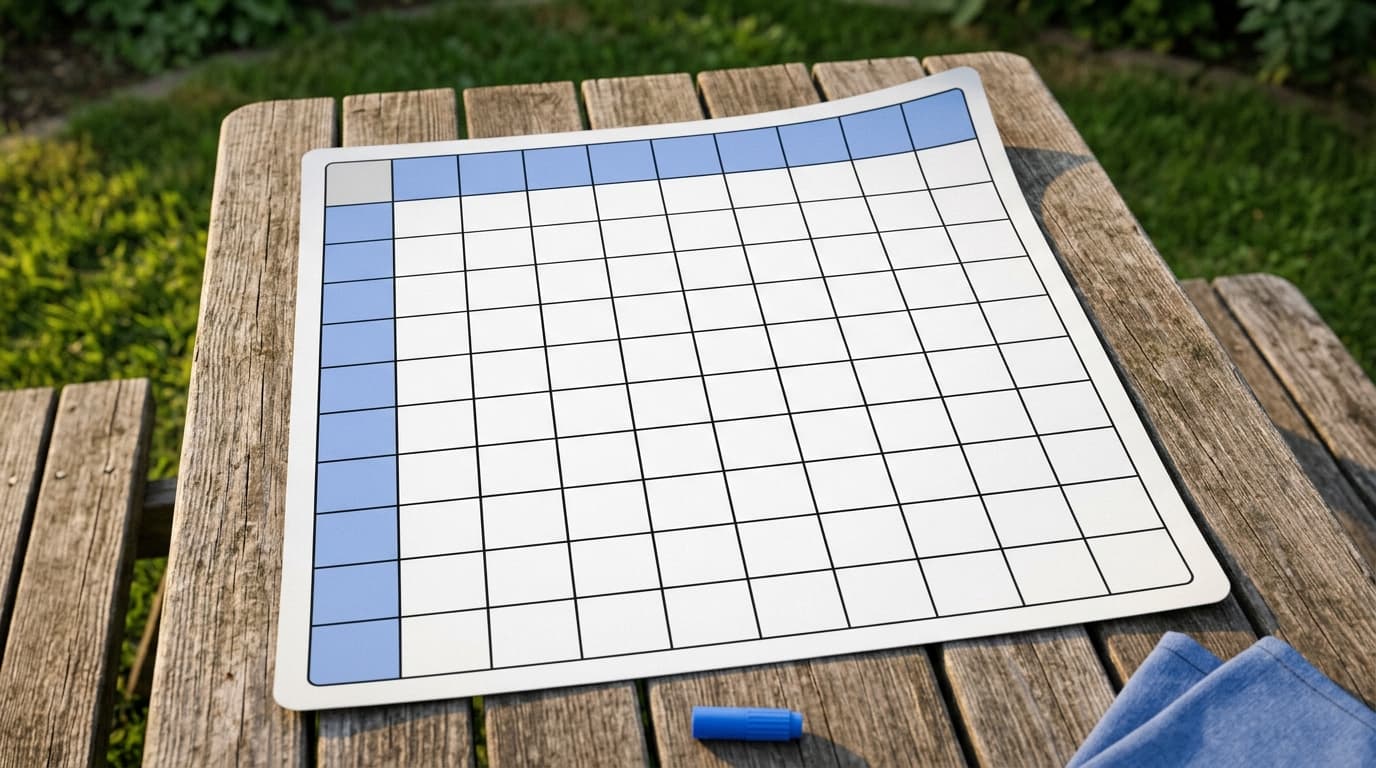
It genuinely doesn't matter which team ends up on which axis, and the default most hosts use is the home team running along the top and the away team running down the left side, since it's easy to remember once first pitch happens. A full hundred-square grid is standard and the most recognizable format, but smaller sizes work too, most commonly a 25-square grid that pairs two digits per axis so a single square covers four of the hundred possible combinations instead of one. Our breakdown of every squares grid size walks through all four standard formats, and the same sizing logic carries over from football to baseball without any changes. Our full guide to hosting a squares pool covers the shared setup steps in more depth if this is your first time running a board of any kind.
Whichever size you pick, sell out the board before touching the numbers. Filling every square first and assigning digits second keeps the whole format fair, and that's exactly what the next section covers.
Why Do Baseball Squares Use Runs, Hits, and Errors Instead of Just the Score?
Baseball squares use the combined total of runs, hits, and errors, written as R+H+E, instead of the raw score because a typical MLB team only crosses the plate three or four times in a nine-inning game. A runs-only board still gives every square a chance, but the winning digit lands on a low number far more often than a high one, so a big share of the grid only wins rarely. Hits and errors happen far more often than runs do, so folding them into the total spreads the winning digit across a much wider range and keeps the defensive side of the game relevant too, not just who crossed home plate.
Here's how the math actually plays out. Say the home team's line reads 4 runs, 9 hits, and 1 error at whatever point in the game a host has chosen to check the board. Add those three numbers together for a combined 14, and the digit that matters for the grid is the last one, a 4. The away team gets the same treatment on its own line: add up its runs, hits, and errors, take the last digit of that total, and find wherever the home team's digit and the away team's digit meet on the board. That square, and whoever's name is written inside it, wins the prize.
Every team keeps its own separate R+H+E line rather than the two teams getting combined into one number, which mirrors exactly how a football or basketball board treats each team's score on its own axis. The only real difference is what gets added up before that final digit gets read off the scoreboard.
R+H+E earns its place on a baseball board for two more practical reasons beyond just spreading the winning digit around. First, it's easy to look up: every one of those three numbers is already sitting right there in the box score the moment a broadcast cuts to it, so nobody's hunting for some obscure stat. Second, it's simply more fun to be cheering for every hit and defensive play in addition to runs, not just the ones that cross the plate. That keeps more of the game exciting, and more fun for everyone in the pool, inning after inning, instead of only caring about the scoreboard.
How Do the Numbers Get Randomized on the Board?
The numbers get randomized by drawing the digits 0 through 9 for each team and placing one along every row and one along every column, done only once the board is completely sold out and every square is paid for. A common way to draw them is pulling folded slips from a bowl one at a time, though a digital board can randomize them instantly with the same result.

Waiting until the board is full before drawing numbers is the detail that keeps the whole game fair. Nobody, not even the host or the person who bought their square first, ever picks which digits they end up holding. Early buyers choose which physical square they want first, but that choice happens before the numbers exist, so it carries no real advantage over anyone who joins later.
Once the digits are drawn and placed, the board locks completely for that game. No swapping squares, no new entries, and no changes of any kind, since every square only had an equal shot at winning before the draw happened. A board that runs across several games, whether a series, a home stand, or a full season, can either keep the same numbers for every game or redraw them before each one, so long as everyone claiming a square knows which approach you're using ahead of time.
How Do You Check Which Square Wins During the Game?
You check which square wins by adding up each team's runs, hits, and errors as the game goes, then finding the square where the last digit of the home team's running R+H+E total crosses the last digit of the away team's. Every point in the game where a host stops to check the board and pay a prize is a scoring period, the same general idea as a quarter in football, and in baseball that scoring period is built around innings. A nine-inning game naturally offers more built-in break points than a four-quarter football game, so a host has real room to decide how often to check and pay.
Some boards keep it simple and pay only once, on the final combined total after nine innings. The standard most hosts land on instead pays three times: the end of the third inning, the end of the sixth inning, and the final combined total, which keeps a rooting interest alive earlier in a game that might otherwise feel slow for anyone who isn't a dedicated fan. If extra innings happen, treat the game's true final combined total, whenever it actually ends, as that last scoring period rather than cutting things off at the end of nine. Hosts can still run their board however works best for their group, and Play Squares lets you add custom or bonus prizes to a pool, so there's plenty of room to get creative with the payout structure, including a separate ninth-inning prize if a group prefers that instead. Virtually any scoring rule is possible with the right setup, so just settle on which one your board is using before the numbers get drawn.
Another scoring option some hosts use is awarding a prize after every single inning instead of just three checkpoints. It's a genuinely good option for a group that wants more winners throughout the game, since more squares win rather than only the handful of squares that happen to line up at the third, the sixth, and the final total. The tradeoff is that each individual prize gets a lot thinner once the same pool is split nine or more ways instead of three, so it suits a group more interested in steady small payouts than a few bigger ones.
A smaller group of hosts add a bonus for the reverse score rule, which pays whoever holds the same two digits flipped between the teams, so if a 4 for the home team and a 7 for the away team wins the main prize, the square holding 7 for the home team and 4 for the away team collects a smaller bonus on top. Treat that one as optional rather than something every board needs, the same way it works on a football board.
Should a Baseball Squares Board Cover One Game, a Series, or the Whole Season?
A baseball squares board can cover any of those three shapes, and unlike a Super Bowl board that only ever has one game to work with, baseball genuinely gives a host choices worth thinking through before the first square sells. Most of what gets written about baseball squares online only ever mentions the postseason, usually the World Series, but there's no rule that says a team needs to be playing in October for squares to work. If October is exactly what you're planning for, our guide to running a World Series squares board covers paying out fairly across a best-of-seven that might end in four games or seven.
A single-game board works for one specific matchup, like a rivalry game or a big regular-season series opener, and plays exactly like the mechanics above. A series board covers a full set of games against one opponent, usually with a fresh number draw before each game so the digits stay fair from one game to the next, and a season-long board follows a favorite team through as much of its 162-game regular season as the group wants to track, with a new prize awarded at the end of each game or each home stand. An office pool built around a hometown team's regular season gives coworkers a reason to check in on the team together for months, not just for one night in October.
None of these shapes require anything special beyond deciding which one you're running before squares go on sale, since the grid, the randomization, and the R+H+E scoring all work identically no matter how many games the board is built to cover.
Doubleheaders are worth planning for too, since baseball is the one major squares sport where two full games can happen on the same day. Treat each game as its own board with its own scoring periods and its own prize, rather than trying to fold two separate sets of runs, hits, and errors into one grid. It adds a little more setup, but it keeps the scoring exactly as clean as a single-game board and gives the group two separate chances to win instead of one.
How Much Does It Cost to Play, and How Does the Prize Pool Get Split?
There's no fixed cost to play baseball squares, since the host sets whatever price fits the group and the occasion. A dollar or two a square keeps things low-key for a casual weeknight game with coworkers, while a board built around a playoff run or a fundraiser can reasonably charge more, since the occasion itself carries more weight. A bigger group splits the same hundred squares across more people, which supports a higher price since each person only needs a few squares to help fill the board, while a smaller group needs each person to claim more squares to sell out, which favors a lower price.
Here's one example shape for splitting a prize pool on a full hundred-square board charging $5 a square, which raises $500. Scale the dollar amounts up or down to match your own price and headcount, since the percentages are the part worth copying.
| Scoring period | Prize | % of pool |
|---|---|---|
| Third inning | $125 | 25% |
| Sixth inning | $125 | 25% |
| Last prize (final R+H+E) | $250 | 50% |
Some hosts simplify further and pay only on the last prize, skipping any mid-game scoring periods entirely, which still uses the same board and the same randomized numbers, just with one payout instead of three. Others use the squares pool as a fundraiser, setting a goal for how much they want the fundraiser to walk away with and doubling that number to land on a starting square price when half of what's collected covers prizes and half goes to the cause.
How Do You Actually Run a Baseball Squares Board Today?
You run a baseball squares board today by handling the whole process online instead of on a printed grid, from selling squares and collecting payment to drawing the numbers and checking runs, hits, and errors after every scoring period. A printed grid still works fine for a small, casual group, but tallying three separate stat categories by hand every few innings puts a lot more work on the host than a simple football score ever did. Our MLB squares page has more on setting up a board for your team.

Play Squares keeps one central record of who claimed which square and who has paid, randomly assigns the numbers the moment the host clicks to draw them, and tracks runs, hits, and errors automatically as the game unfolds, adding them up and checking every square against the running R+H+E total without anyone reaching for a calculator. That matters even more for baseball than it does for a football or basketball board, since manually adding three numbers together for both teams every half-inning is exactly the kind of tedious math a digital board removes entirely.
Play Squares also tracks the score in real time while the game is still being played, not just once a scoring period officially closes, and shows the pending winner for the current scoring period if the combined total holds where it stands right now. That gives every player an easy way to glance at the board and see whose square is on track to win, not just who already won a scoring period that already closed out.
That live view pays off most in what it removes: nobody has to text or message the host to ask whether their square won, what the current combined total is, or which numbers they even have again. With one single, central, online board, every player checks that for themselves in real time instead of pinging the host mid-game. That saves real time for the host and every player, and it makes a long nine-inning game more fun to follow, since everyone is watching the board update live instead of waiting on a text back.
Frequently Asked Questions
What is R+H+E, and why do baseball squares use it instead of the score?
Can you run baseball squares for the regular season, or only the playoffs?
How many innings does a baseball squares board cover?
What happens if extra innings are needed?
What happens if the same square wins more than once in a game?
How much does it cost to play baseball squares?
Do you need to follow baseball closely to play squares?
Ready to Set Up Your Board?
Play Squares handles the grid, the number draw, payment tracking, and live R+H+E scoring through every inning, so your board runs itself once the squares sell out.