Football Squares Template
Type in the two teams, what a square costs and what each quarter pays, and this football squares template prints a finished sheet for any game on the schedule, from a Thursday night NFL game to a college rivalry on Saturday. Pick the 100-square board or the 25-square one, and the two number bands print empty so you can do the draw once the sheet fills. There's no signup and nothing to download.
How do you make a football squares sheet?
Fill in the form above, print the sheet, and pass it around so everyone writes their name into the squares they want, then draw the numbers once the last square is paid for. Because the price, the prizes and your house rule are already printed on the page, nobody has to ask you what a square costs or what the first quarter pays.
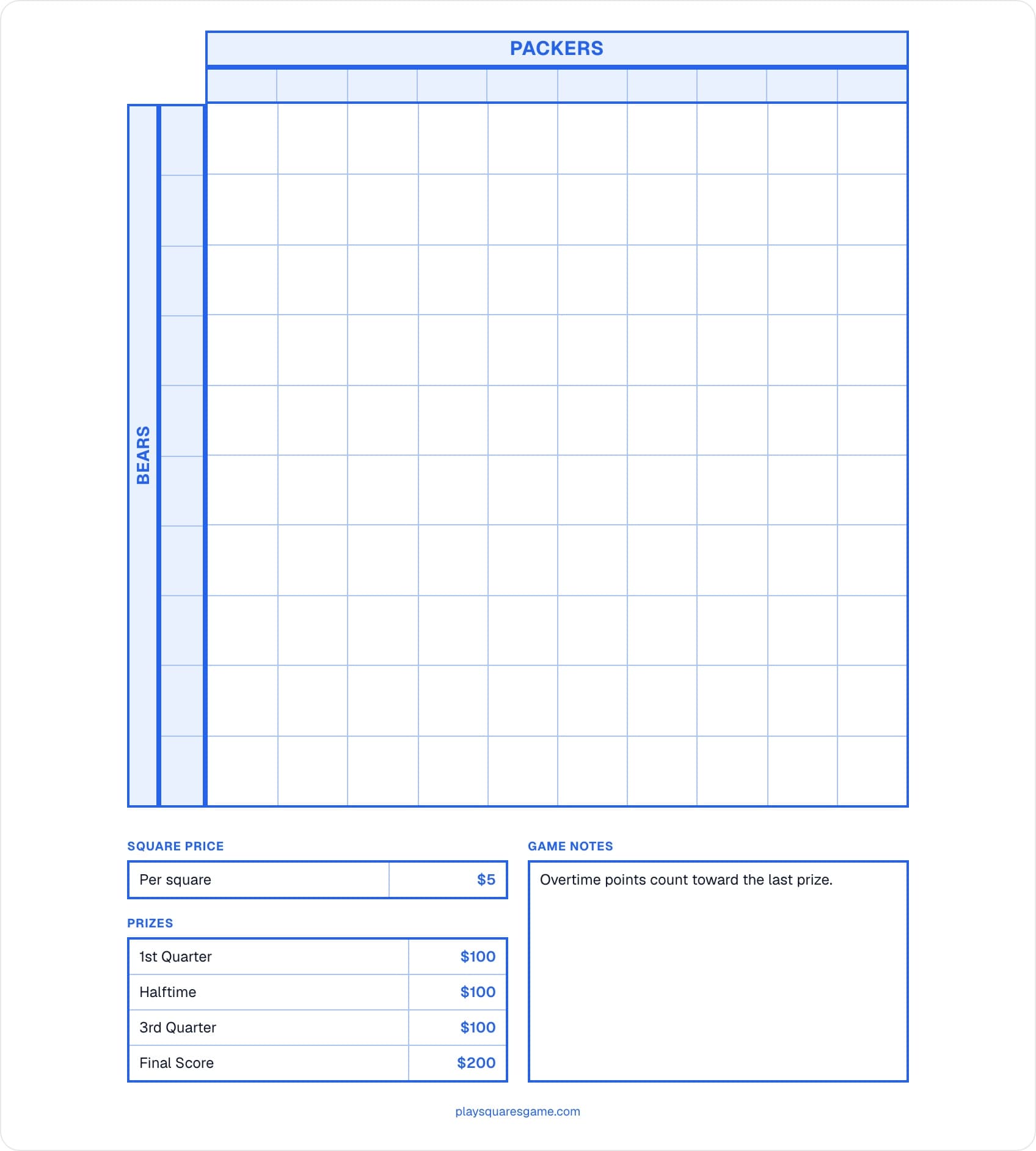
The form also works out what a full board collects as you type, so you know the size of the prize pool before you decide what each quarter pays. The note line on the sheet is where your group's decisions go, such as whether overtime points count or whether the reverse score rule pays anyone. Both digit bands stay blank on purpose, because numbers written onto a sheet before it fills would let the last person to claim a square see exactly which digits it covers.
When the sheet is full, the football squares number generator draws both rows at random in front of everyone, and you copy the digits straight onto the paper so nobody can say the draw happened out of sight.
How much does a football squares pool pay?
A football squares pool pays out prizes from what it collects, so the most it can hold is the price of one square multiplied by the number of squares on the sheet. A $50 square on a full 100-square board makes a $5,000 prize pool, and the same price on a 25-square sheet makes $1,250.
| Price per square | 100-square sheet | 25-square sheet |
|---|---|---|
| $1 | $100 | $25 |
| $5 | $500 | $125 |
| $10 | $1,000 | $250 |
| $25 | $2,500 | $625 |
| $50 | $5,000 | $1,250 |
According to our data, the most common prices for NFL and Super Bowl squares are $1, $2, $5 and $10, which makes a sensible starting point for a game among friends. A higher price is harder to sell but raises more once the sheet fills, while a lower price fills quickly and caps what the winners take home, so pick the number your group will actually buy out.
The placeholder amounts in the prize boxes show one simple shape, with the same prize for the first three quarters and a bigger last prize. On that $5,000 board it would mean $1,000 each for the first quarter, halftime and the third quarter, then $2,000 for the last prize, although paying all four the same is just as valid and trades a bigger finish for more evenly sized prizes. Print them as real dollar amounts rather than percentages, because your players are buying in against the numbers they can see on the sheet. Football Squares Payouts walks through every split, including what to do when squares go unsold.
How do you work out who won a quarter?
Take the last digit of each team's score at the end of the quarter, find those two digits in the number bands, and the square where that column and row meet is the winner. If the Packers lead the Bears 17 to 10 after the first quarter, the winning square sits under the Packers' 7 in the top band and level with the Bears' 0 down the side.
Halftime uses the score at the half, the third quarter uses the score after three, and the last prize uses the score when the game ends. A scoreless quarter still pays out, and it simply goes to whoever holds the 0 and 0 square. Decide before kickoff whether overtime points count toward the last prize or whether it pays on the score at the end of regulation, since both are perfectly fine and the only wrong choice is making it after the fact. College football has its own overtime format, but the same sheet and the same decision work there too, and Football Squares Rules covers ties, repeat winners and the reverse score rule if your group wants to add it.
Can you use one template for every game of the season?
Yes, as long as you print a fresh sheet and run a fresh draw for every game, because the numbers are only fair when nobody knows them while they're choosing a square. Carrying last week's digits onto this week's sheet would let everybody see which positions hold which numbers before they claim, and whoever moved first would grab the pairings they liked best.
Nothing you type into the form gets saved, so keep your price, prizes and house rule written down and put them back in with the new team names each week. A board you run all season fills or stalls on price more than anything else, which means a number your group is happy to pay every Sunday or every Saturday matters more than the biggest total from a single game. If a week doesn't sell out, the cleanest fix is buying the remaining squares yourself at the same price, so the prizes printed on the sheet still reach real players.
Running a board every week is also where paper starts to feel like work, and the NFL squares page shows how the same weekly pool runs online with a new board for each game. For the big game in February, the Super Bowl squares template prints this same sheet with advice aimed at a party crowd.
Should you print 100 squares or 25?
Print 100 squares for the classic board, where each square covers one exact pair of last digits, and print 25 when you want fewer squares to sell. On the 25-square sheet each band cell holds two digits, so every square covers four different score combinations, and that's worth explaining to anyone who hasn't played that version before.
You'll also come across 50-square sheets, which pair the digits along only one side of the grid, but this template sticks to 100 and 25 because they're the two sizes most pools use on paper. A smaller group can run the 100-square board without any trouble, since people simply claim a few squares each. How Many Squares Are in a Football Pool compares every size, and a board you create online with Play Squares can be 100, 25, 10 or 4 squares.
When does a printed sheet stop being enough?
A printed football squares template works well until your players start asking questions the paper can't answer, which usually happens around the second quarter when half the room wants to know whether their square is still in the running.
| Job | Printed template | Play Squares board |
|---|---|---|
| Claiming squares | Everyone writes on the one sheet, so they have to be in the room | Players claim from their own phones, wherever they happen to be |
| Tracking who has paid | A separate list you keep next to the sheet | One record on the board, with your payment links shown to players |
| Drawing the numbers | Done by hand or with a generator, then copied onto the bands | Randomized on the board itself, with nothing to copy over |
| Knowing who's winning mid-game | Whoever holds the sheet works it out and tells everyone | The board shows the pending winner as the score changes |
Play Squares tracks NFL and college football scores automatically, and while a quarter is still being played the board highlights whoever is on track to win it if the score holds, so players check for themselves instead of texting you. The football squares online page shows how that looks on a real board, and printing this template for a family game while running the office pool online is a perfectly good way to do both.
Frequently Asked Questions
Is this football squares template really free?
Does the football squares template work for college football?
Can I get a football squares template with the numbers already on it?
What paper does the template print on?
How much does a $50 square football pool pay?
Are football squares legal?
Running a board every week this season?
Play Squares keeps the board, the claimed squares, the payment tracking and the live scores in one place, and your players follow every quarter from their own phones. Set up your football squares pool in minutes.